
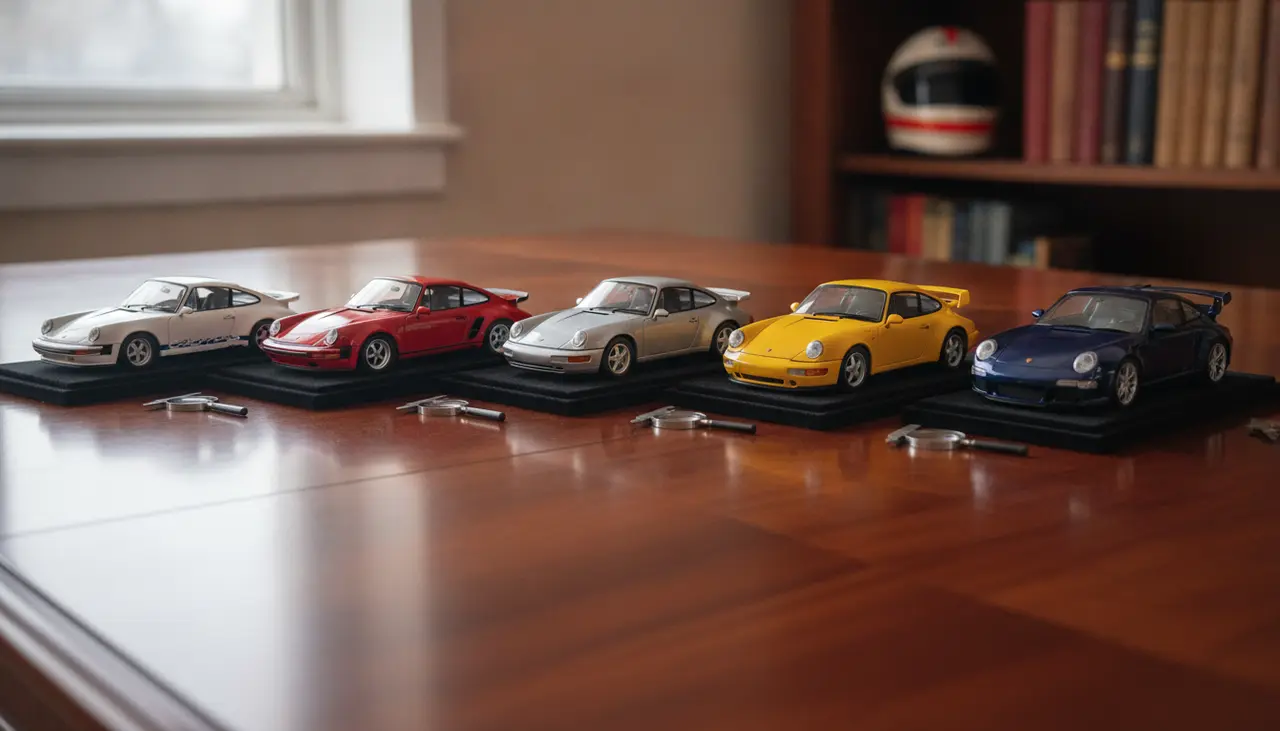
Top 5 Classic Porsche 911 Replicas Compared: A Collector’s Deep Dive
For many of us, the silhouette of a classic Porsche 911 isn't just a car design—it’s a piece of kinetic art. Whether it’s the original 1964 "901" or the flared arches of a 930 Turbo, adding a Porsche 911 diecast model to your shelf is a rite of passage for any serious automotive collector. But with dozens of manufacturers vying for your attention, how do you distinguish a museum-quality investment from a standard shelf-filler?
If you are looking for the absolute pinnacle of detail, the CMC Porsche 901 (1964) is widely considered the gold standard due to its high part count and use of authentic materials like leather and metal. For collectors who prioritize a balance of opening parts and paint finish at a more accessible premium price, the Autoart 911 (901 or 930 versions) remains the most popular choice. If shelf presence and modern resin "curb appeal" are your goals, GT Spirit offers exceptional exterior proportions, though they lack opening features.
Who This Guide Is For
This deep-dive is designed for the discerning collector who balances a busy professional life with a passion for historical accuracy. You likely value the weight of zinc alloy, the precision of tampography (printed logos), and the long-term appreciation potential of limited-run replicas. We are focusing on "classic" air-cooled generations, specifically the 901, G-Series, and 964.
Classic Porsche 911 Replica Comparison Table
| Manufacturer | Primary Material | Scale | Opening Parts | Notable Feature |
|---|---|---|---|---|
| CMC | Zinc Alloy/Multi-media | 1:18 | All (Hood, Doors, Engine) | 971+ individual parts, leather seats |
| Autoart | Composite/Diecast | 1:18 | All (Hood, Doors, Engine) | Exceptional shut-lines and paint |
| Norev | Zinc Alloy | 1:18 | Varies (Usually All) | Best price-to-detail ratio |
| Schuco | Zinc Alloy | 1:18 | All (Hood, Doors, Engine) | Heavy, traditional "old school" feel |
| GT Spirit | Resin | 1:18 | None (Sealed) | Superior body stance and paint depth |
1. The "Holy Grail": CMC Porsche 901 (1964)
When we talk about the CMC 901, we aren't just talking about a model; we're talking about an engineering feat. CMC is famous for using hundreds of individual parts to recreate the car exactly as it was built in Stuttgart.
- Best for: The "completionist" collector who wants a centerpiece that stands up to macro-photography.
- The Tradeoff: These models are significantly more expensive and fragile. Moving parts like the delicate hood latches require a steady hand and a lot of patience.
- Pro Tip: Always use the included tweezers and gloves. The natural oils from your skin can react with the high-grade paint and metal over time.
2. The Professional Standard: Autoart Porsche 911 (901/930)
Autoart has transitioned many of its newer models to a "composite" material, but their classic 911s—especially the 930 Turbo—remain benchmarks for the hobby.
- Best for: Collectors who want a "tactile" experience. The doors on an Autoart model often have a satisfying "click" and the hinges are scaled realistically rather than using "dog-leg" style brackets.
- The Tradeoff: Older diecast metal versions can be prone to "zinc pest" if stored in humid environments, though this is rare. Newer composite versions are lighter, which some "old school" collectors find less premium.
- Internal Insight: To understand why some collectors prefer these traditional builds over modern alternatives, check out our guide on Diecast vs. Resin Models: The Collector’s Guide to Choosing Your Next Masterpiece.
3. The Value Champion: Norev Porsche 911 S / Carrera
Norev has carved out a fantastic niche by providing diecast models with opening parts at roughly half the price of an Autoart.
- Best for: Filling out the "evolution" of the 911 in your display without breaking the bank. They are sturdy, well-painted, and look excellent behind glass.
- The Tradeoff: The interior detailing (carpeting and dashboard dials) won't be as crisp as CMC or Autoart. You may see slightly thicker paint around the door handles.
4. The "Stance" Specialist: GT Spirit 911 (964/993)
GT Spirit produces resin models. This means the doors and hood do not open. While that might be a dealbreaker for some, resin allows for much sharper body lines and more accurate "stance."
- Best for: Displaying on a high shelf where you won't be handling the model often. The paint finish on resin is often smoother than diecast because the material doesn't require the same thickness of primer.
- The Tradeoff: No engine detail to look at. If you love showing off the flat-six engine bay, look elsewhere.
5. The Traditionalist: Schuco 1:18 Porsche 911 S
Schuco models feel like they were built to last a century. They are heavy, made of thick zinc alloy, and often include functional features like working steering and suspension.
- Best for: The collector who misses the "heft" of vintage models but wants modern-day accuracy.
- The Tradeoff: Sometimes the "scale" of the small parts (like wipers) can look a bit chunky compared to the ultra-thin photo-etched parts found on a CMC.
Common Beginner Mistakes to Avoid
- Ignoring the Scale: Before buying, decide if you are a 1:18 or 1:43 collector. Mixing them on the same shelf can make your display look cluttered. For more on this, refer to The Diecast Collector Pro Master Buying Guide.
- Sunlight Exposure: Never display your Porsche 911 diecast model in direct sunlight. UV rays will fade the Guards Red or Riviera Blue paint and can cause the decals (tampography) to crack.
- Discarding the Box: For premium brands like CMC or Autoart, the original packaging can represent 20-30% of the model's resale value. Store the boxes in a dry, climate-controlled area.
Frequently Asked Questions (FAQ)
Q: Is resin or diecast better for a Porsche 911 model? A: It depends on your preference. Diecast offers opening parts and "weight," while resin offers better exterior proportions and paint finish but remains "sealed" (no opening parts).
Q: Why are CMC models so much more expensive? A: CMC models are hand-assembled from upwards of 1,000 parts. They use real leather, copper wiring in the engine, and functional leaf springs. You are paying for miniature engineering, not just a "toy."
Q: Where is the best place to find retired Autoart 911s? A: Specialty auction sites and dedicated collector forums are your best bet. Always check for "A-pillar" damage or paint rash before committing to a high-priced secondary market purchase.
Affiliate Disclosure: This guide contains links to premium retailers. If you choose to purchase a model through these links, we may earn a small commission at no additional cost to you, which helps us continue to provide deep-dive technical reviews for the collecting community.