
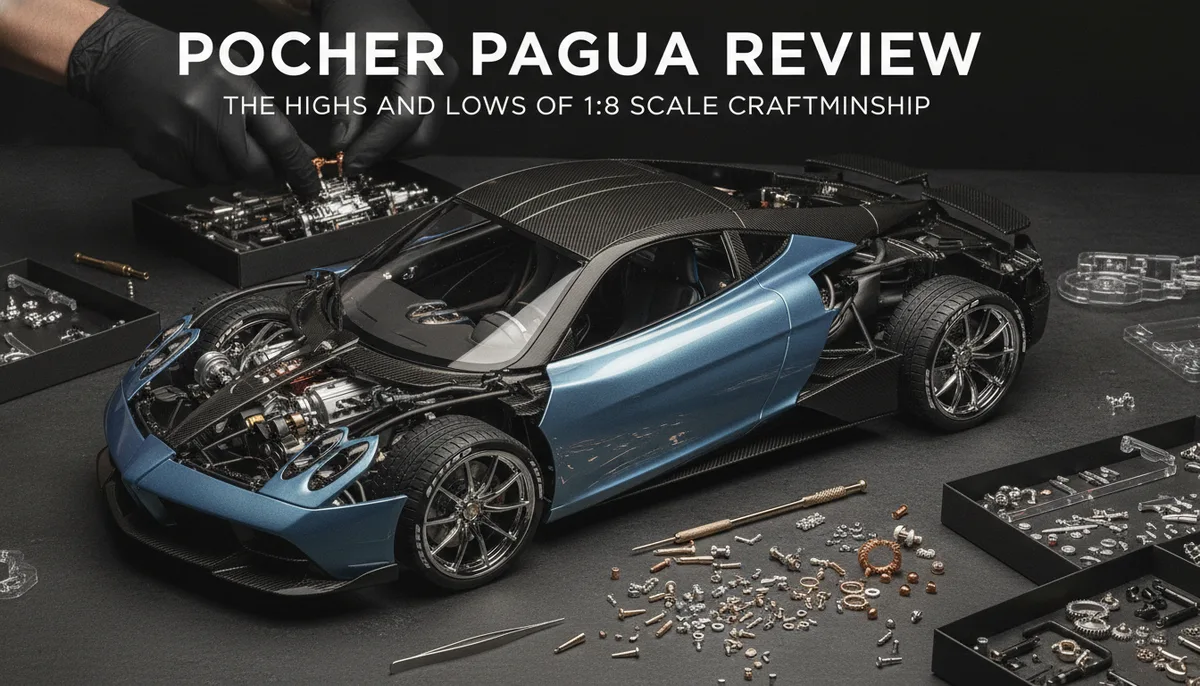
Pocher Pagani Utopia Review: The Highs and Lows of 1:8 Scale Craftsmanship
The world of large-scale model building is often divided into two categories: high-end pre-built replicas and the immersive, often grueling journey of a Pocher kit. With the release of the Pocher 1:8 Pagani Utopia, the legendary brand attempts to bridge the gap between pure hobbyist assembly and the refined elegance of automotive art.
At a finished length of approximately 60 cm, this isn't just a model; it is a centerpiece. However, with a part count exceeding 556 pieces and a price tag that reflects its "supercar" status, the Utopia demands a significant investment of both time and money. In this review, we break down "The Good, the Bad, and the Ugly" to see if this ambitious kit delivers on its promise of master-level craftsmanship.
The Legacy of Pocher Meets Pagani’s Artistic Vision
Pocher has long been synonymous with "prestige" in the 1:8 scale world. Historically known for their incredibly complex classic Mercedes and Rolls-Royce kits, the modern era of Pocher has shifted toward contemporary hypercars. The Pagani Utopia is a natural fit for this format. Horacio Pagani’s design philosophy—where "Art and Science" walk hand-in-hand—requires a model kit that doesn't just replicate a shape, but also the textures and mechanical soul of the vehicle.
The Utopia itself is a departure from the digital-heavy hypercars of the modern era, focusing on a "timeless" aesthetic and a manual driving experience. Translating that tactile, analog feel into a 1:8 scale kit is no small feat. For collectors who have read The Diecast Collector Pro Master Buying Guide: Precision, Quality, and Value, the Pocher Utopia represents the pinnacle of "Quality" and "Precision," though it brings its own set of unique assembly challenges.
Pocher Pagani Utopia 1:8 scale model kit
Anatomy of the Build: 556 Parts and a Twin-Turbo V12
The heart of any Pocher kit is the assembly process. Unlike a standard 1:18 scale die-cast that comes ready for the shelf, the Utopia requires you to act as the factory technician.
The Engine: A Miniature Masterpiece
The Pagani twin-turbo V12 is the crown jewel of this kit. With hundreds of parts dedicated solely to the drivetrain, the level of detail is staggering. You aren't just looking at a plastic block; you are assembling the intake manifolds, the turbochargers, and the intricate exhaust system that Pagani is famous for. The use of multiple materials helps differentiate the look of heat-shielding, carbon fiber, and cast metal.
The Chassis and Body
The weight of the kit is primarily found in its die-cast metal body panels. These come pre-painted, which is both a blessing and a curse. While it ensures a high-quality "factory" finish, it also means the builder must be extremely careful during assembly to avoid chipping the paint. The chassis serves as the backbone, integrating the suspension components and the interior tub.
The "Good": Where the Pocher Utopia Shines
There are moments during the build of the Pocher Utopia where the engineering feels genuinely revolutionary.
- Presence and Scale: At 60 cm, the sheer presence of the model is undeniable. It commands attention in any room. The proportions are spot-on, capturing the Utopia’s unique blend of retro-futurism and aerodynamic flowing lines.
- Material Variety: Pocher has done an excellent job of mixing die-cast metal, high-quality plastics, and rubber. This variety prevents the model from looking like a "toy" and gives it the weight and feel of a real machine.
- The Opening Features: The "butterfly" doors and the front and rear clamshells operate with a satisfying weight. When opened, they reveal the internal bracing and the engine bay in a way that smaller scales simply cannot replicate.
If you are transitioning from smaller models, you might find our guide on Choosing Your First 1:18 Scale Model: A Beginner’s Guide to Premium Diecast helpful for understanding the baseline of premium quality before jumping into the 1:8 scale deep end.
professional model building tool kit for 1:8 scale
The "Bad" and "Ugly": Navigating the Challenges
No kit of this complexity is without its flaws. The "Bad" and "Ugly" aspects of the Pocher Pagani Utopia often stem from the tension between mass production and high-end engineering.
Fitment and Tolerances
One of the most common complaints with large-scale die-cast kits is the fitment of the heavy metal panels. Because metal doesn't flex like plastic, if a screw hole is slightly off-center or a hinge is misaligned by a fraction of a millimeter, it can cause significant gaps in the bodywork. Builders have reported that certain sections require "finessing"—a polite term for careful sanding or forced alignment—to get the perfect shut-lines.
The Instructions
While Pocher has improved their manuals over the years, a kit with 556 parts requires absolute clarity. There are stages in the Utopia build where the diagrams can be ambiguous, leading to "re-work" where you have to disassemble a section to fix a part that was installed backwards three steps ago.
Quality Control (The "Ugly")
The "Ugly" side of the experience often involves QC issues. From missing screws to small paint imperfections on the large die-cast panels, these issues can be frustrating given the premium price point. Furthermore, the sheer size of the parts makes them vulnerable to damage during shipping if the internal packaging isn't perfect.
Displaying and Maintaining Your 60cm Masterpiece
Once the hundreds of hours of assembly are complete, you are left with a massive, heavy, and somewhat fragile piece of art. Maintenance for a 1:8 scale model is different than a standard 1:64 or 1:18 car.
Because of the intricate engine bay and the open-air nature of the Pagani design, dust is your primary enemy. The Utopia has many "nooks and crannies" where dust can settle and become difficult to remove without breaking small plastic sensors or wires. We highly recommend following the techniques in How to Clean and Dust Your Models Safely: The Ultimate Preservation Guide for Diecast Collectors to ensure your build stays in museum-quality condition.
Display Tips:
- Weight Considerations: Ensure your shelving can handle upwards of 15-20 lbs (7-9 kg).
- Lighting: Use LED lighting that doesn't emit UV rays, as long-term exposure can fade the interior plastics and the paint over several years.
- Acrylic Cases: Given the investment, a custom acrylic display case is almost mandatory to protect the model from accidental bumps and environmental debris.
1:8 scale acrylic display case
Final Verdict: Is the Pocher Pagani Utopia Right for Your Collection?
The Pocher 1:8 Pagani Utopia is not a product for the faint of heart or the impatient. It is a marathon, not a sprint.
The Verdict:
- For the Builder: If you enjoy the process of mechanical assembly and the satisfaction of overcoming engineering hurdles, this is one of the most rewarding kits on the market.
- For the Collector: If you simply want a perfect Pagani Utopia for your shelf without the "headache" of building it, you might be better off looking at high-end resin brands like BBR or MR Collection (though they rarely produce in 1:8 scale).
- Value: While expensive, the finished product's scale and detail offer a level of "wow factor" that 1:18 models cannot match.
In the end, the Pocher Utopia represents the "Good, the Bad, and the Ugly" of the hobby. It is a flawed masterpiece that, when finished correctly, stands as a testament to the builder's skill and the incredible design of the Pagani brand. It is a journey through 556 parts that ends with one of the most impressive replicas ever conceived in die-cast metal.