
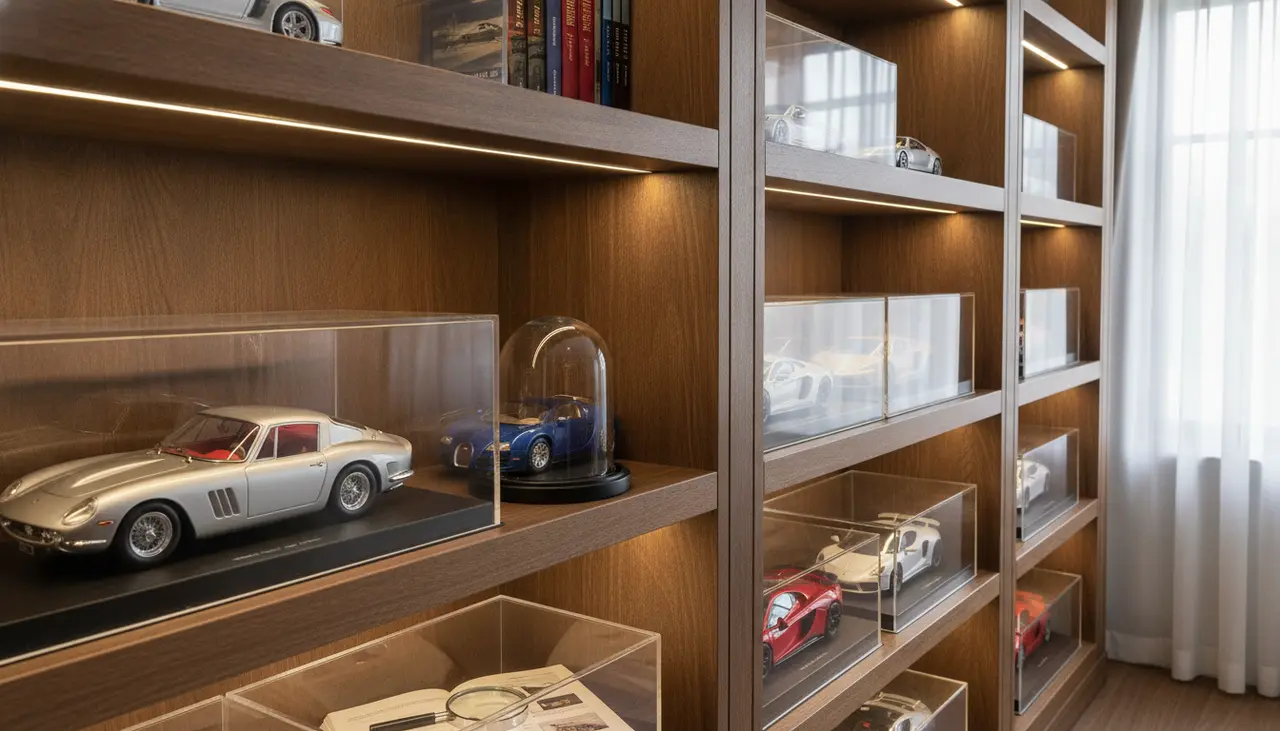
Display Case Buyer's Guide: Protecting Your Investment
Disclosure: This post contains affiliate links. If you click through and make a purchase, we may earn a commission at no additional cost to you. We only recommend products that meet the high standards of the Diecast Collector Pro community.
Choosing the right diecast display cases is a balance between visual clarity and long-term preservation. For high-end collections involving brands like Autoart, CMC, or BBR Models, the primary goal is to mitigate environmental risks—specifically dust accumulation and UV radiation—which can degrade paint finishes and brittle resin parts over time. Individual acrylic cases are ideal for protecting high-value 1:18 scale models, while tempered glass cabinets are the preferred choice for showcasing large-scale collections in a unified "showroom" environment.
The Collector’s Dilemma: Why Display Matters
We’ve all been there. You finally track down that rare, limited-edition Ferrari or a meticulously detailed 1:18 scale CMC classic. You unbox it, marvel at the zinc alloy weight and the precision of the engine bay, and then realize: where is it safe?
Leaving a premium model exposed on a shelf is a recipe for heartache. Dust is abrasive, and the oils from our skin can react with high-end paint over time. More importantly, if you’ve consulted The Diecast Collector Pro Master Buying Guide: Precision, Quality, and Value, you know that these models are true investments. A display case isn't just a box; it’s an insurance policy for your collection’s resale value and physical integrity.
Comparing Display Materials: Acrylic vs. Glass
When shopping for diecast display cases, you will primarily choose between acrylic (PMMA) and tempered glass. Each has specific trade-offs regarding weight, clarity, and safety.
| Feature | Acrylic (Premium) | Tempered Glass |
|---|---|---|
| Clarity | Extremely High (92% light transmission) | High (Can have a slight green tint) |
| Weight | Lightweight and easy to move | Heavy and requires stable furniture |
| UV Protection | Often built-in or available as an upgrade | Minimal unless specifically treated |
| Durability | Shatter-proof but prone to scratches | Scratch-resistant but can shatter |
| Best For | Individual 1:18 or 1:43 desktop displays | Multi-car floor-to-ceiling galleries |
Top Tiers of Protection: Use-Case Recommendations
The Individual "Hero" Display (Best for 1:18 Scale)
If you have a centerpiece model—perhaps a resin casting from BBR or a full-opening Autoart Composite—a single-car acrylic case is the gold standard. Look for cases with a "mirror base" or a "leatherette base" to add a touch of luxury.
- Why it works: These cases offer a tight seal against dust. Because they are individual units, you can rearrange your display without moving the entire collection.
- Pro Tip: Ensure the internal height allows for "opening parts" to be displayed if you prefer showing off the engine detail.
The Wall-Mounted Grid (Best for 1:43 and 1:64 Scale)
For collectors of 1:43 Minichamps or premium 1:64 models, floor space becomes an issue quickly. Wall-mounted acrylic grids allow you to see the side profiles of dozens of cars at once.
- Why it works: It keeps the models at eye level and away from curious hands or pets.
- Consideration: Make sure the mounting hardware is anchored into studs; a grid of 50 diecast cars is surprisingly heavy.
The Professional Glass Cabinet (Best for Large Collections)
When your collection grows past 20+ models, individual cases become expensive and bulky. A dedicated glass cabinet (like the popular IKEA Detolf or higher-end specialty cabinets) provides a cohesive look.
- Why it works: It creates a "museum" atmosphere.
- The Trade-off: Most stock glass cabinets are not dust-proof. You will likely need to apply aftermarket weather stripping or "dust seals" to the door gaps to keep your models pristine.
The Two Silent Killers: UV Light and Dust
UV Protection Even if your models aren't in "direct" sunlight, ambient UV rays can cause "paint rash" or yellowing of white decals (tampography). High-end acrylic cases often feature UV-filtering properties that block up to 98% of harmful rays. If you are displaying resin models, UV protection is non-negotiable, as resin is more sensitive to heat and light than zinc alloy.
Dust-Proofing Dust isn't just unsightly; it’s a cleaning hazard. Every time you have to wipe down a model, you risk snapping off a delicate pitot tube, side mirror, or antenna. A high-quality case should have a snug-fitting lid. If you are using a larger cabinet, refer to our guide on how to clean and dust your models safely to ensure that when you do perform maintenance, you don't damage the finish.
Common Beginner Mistakes to Avoid
- Using Household Glass Cleaner on Acrylic: Never use Windex or ammonia-based cleaners on acrylic cases. It will cause "crazing" (tiny cracks) and permanent cloudiness. Use a dedicated plastic cleaner and a clean microfiber cloth.
- Ignoring Weight Limits: Glass shelves have limits. A 1:18 scale CMC model can weigh several pounds. Overloading a shelf can lead to a catastrophic failure that destroys multiple models.
- Direct Sunlight Placement: Even with UV-rated acrylic, never place your display in front of a window. The heat buildup inside the case can soften adhesives and damage tires.
Frequently Asked Questions
Q: Should I keep the original box if I use a display case? A: Absolutely. For premium brands like Kyosho or Autoart, the original packaging can represent 10-20% of the model's resale value. Store the boxes in a temperature-controlled, dry area.
Q: Are mirror bases better than plain bases? A: It’s a matter of preference. Mirror bases allow you to see the undercarriage detail and chassis numbering without picking up the model, which is a huge plus for high-end replicas with detailed suspension.
Q: How do I stop dust from getting into my large glass cabinet? A: Use transparent adhesive brush seals or foam strips designed for cabinets. Apply them to the gaps around the door. It’s a small weekend project that saves hours of dusting later.
Whether you are just starting with a few pieces or managing an expansive gallery, the right diecast display cases transform a hobby into a professional-grade archive. Protect your investment today so it remains a masterpiece for years to come.