
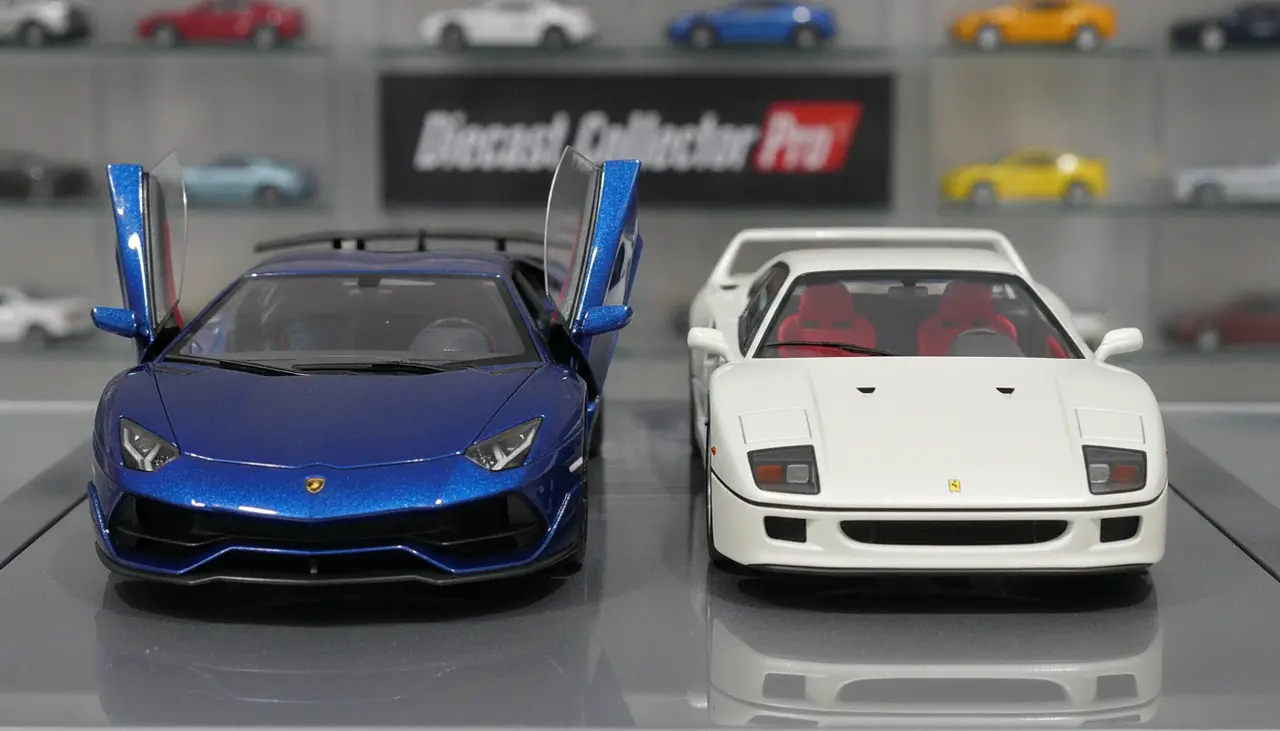
Autoart vs. Kyosho: Which Premium Brand Wins the 1:18 Battle?
Affiliate Disclosure: This post contains affiliate links to premium retailers. If you make a purchase through these links, we may earn a small commission at no additional cost to you, which helps us continue providing high-quality collector guides.
If you’ve been collecting for a while, you know the feeling. You’re staring at two different listings for a 1:18 scale legend—perhaps a Lamborghini or a classic BMW—and you see the names: Autoart and Kyosho. Both represent the upper echelon of the hobby, but they offer vastly different experiences for the collector who values precision and historical accuracy.
Choosing between them isn't just about price; it’s about what you value most when you hold a model in your hands or see it under the LED lights of your display case.
The Short Answer: Which Brand Wins?
In the Autoart vs. Kyosho comparison, the "winner" depends on your preference for material and mechanical precision. Autoart is the current leader in engineering, particularly with its "Composite" line that allows for tighter shut lines (the gaps between doors and the body) and incredibly intricate opening mechanisms. If you want a model that looks like a real car shrunk down by a physics-defying ray, Autoart is often the choice.
Kyosho, on the other hand, is the champion of "shelf presence" and traditional feel. They have largely stuck to heavy zinc alloy (diecast metal), providing a satisfying weight that many veteran collectors prefer. Their paint depth and interior textures often feel more "organic" and substantial, making them the go-to for classic European marques and vintage sports cars.
Who Is This Guide For?
This deep dive is for the collector who has moved past budget-friendly brands and is ready to invest $150 to $300+ into a single piece. If you are someone who notices the difference between a sticker and a photo-etched badge, or if you care about the "click" of a door hinge, this comparison is for you. We understand that your shelf space is limited and your time is valuable—we’re here to ensure your next addition is one you won't regret.
For those just starting their journey into high-end replicas, you might find our The Diecast Collector Pro Master Buying Guide: Precision, Quality, and Value helpful for understanding the broader market.
Autoart vs. Kyosho: At a Glance
| Feature | Autoart (Signature/Composite) | Kyosho (Original/High-End) |
|---|---|---|
| Primary Material | ABS Composite / Zinc Alloy (older) | Zinc Alloy (Diecast Metal) |
| Opening Parts | Full opening (Doors, Hood, Trunk) | Usually full opening |
| Paint Finish | Thin, precise, and consistent | Deep, lustrous, high-gloss |
| Interior Detail | High-tech, molded textures | Soft-touch materials, carpeting |
| Hinge Work | Realistic "dog-leg" or swan-neck | Traditional sturdy hinges |
| Price Range | $180 – $350+ | $150 – $250+ |
The Visual Hook: Paint Finish and Interior Detail
The Autoart Precision
Autoart has shifted much of its production to a Composite material (a mix of ABS and a diecast inner frame). While some purists miss the weight of metal, the benefit is in the paint. Because the composite body is thinner than cast metal, the paint doesn't "pool" in the panel gaps. This results in incredibly sharp lines and realistic tampography (printed logos and badges) that look painted on rather than stuck on.
Inside an Autoart, you’ll find surgical precision. The dashboards often feature individual gauges with clear lenses and tiny, legible switches. If you are looking for modern supercars where carbon fiber patterns and technical textures are key, Autoart’s execution is hard to beat.
The Kyosho Soul
Kyosho models feel like "old school" luxury. Because they primarily use zinc alloy, the models have a significant heft. Their paint finish is legendary for its depth—specifically on their older Ferrari and BMW releases. When you look at a Kyosho, the reflections are often smoother and more "liquid" than the slightly more clinical finish of an Autoart.
Kyosho’s interiors often excel in tactile feel. They are known for using realistic carpeting and sometimes even "soft-touch" plastics that mimic leather better than the harder polymers found in some Autoart models.
Best Use Cases: Which Should You Buy?
Best for Modern Supercars & Hypercars: Autoart
If your collection focuses on Pagani, Koenigsegg, or modern Lamborghinis, Autoart is the gold standard. Their ability to replicate complex active aerodynamics (moving wings) and intricate engine bays using composite materials is unmatched in the mid-high price bracket.
Best for Classic European Icons: Kyosho
For fans of the BMW E30, classic Ferraris (if you can find them on the secondary market), or vintage Lancias, Kyosho captures the "soul" of these cars. The weight of the metal and the richness of the paint suit these historic vehicles perfectly.
If you are currently looking for your first high-end piece, we recommend checking out Choosing Your First 1:18 Scale Model: A Beginner’s Guide to Premium Diecast to see where these brands fit in your collection strategy.
Tradeoffs and Considerations
Autoart Tradeoffs:
- The "Plastic" Feel: Some collectors find the composite bodies feel "cheap" because they are lighter than metal, despite being more expensive to engineer.
- Fragility: The extreme detail in the hinges and mirrors means they can be very delicate during unboxing.
Kyosho Tradeoffs:
- Paint Rash: A common issue with older Kyosho diecast is "paint rash" or bubbling, caused by impurities in the zinc alloy. While modern releases have improved, it is something to watch for in older stock.
- Stiffer Hinges: Compared to Autoart’s sophisticated hinges, Kyosho can sometimes feel a bit more "toy-like" in how the doors operate.
Collector Basics: Common Beginner Mistakes
- Judging Quality by Weight: Don't assume a lighter Autoart Composite model is lower quality than a heavy Kyosho. The composite allows for detail that metal simply cannot achieve at this scale.
- Forcing Parts: Never force a door or hood. Both brands use tiny, realistic latches that can snap if you don't use the provided plastic opening tool (often included in the box).
- Ignoring the Box: Always keep the original packaging. For brands like Autoart and Kyosho, the box can represent 20-30% of the resale value.
FAQ
Q: Does Autoart still make metal cars? A: Most new releases are "Composite," but they still produce a limited number of diecast metal models. You have to check the specific product description for each release.
Q: Why are Kyosho Ferraris so expensive now? A: Kyosho lost the Ferrari license years ago. Since they can no longer produce them, the existing models have become highly sought-after "Rare & Limited Editions" on the secondary market.
Q: Which brand holds its value better? A: Both hold value well, but Autoart "Signature" series and discontinued Kyosho "High-End" series tend to appreciate the most, especially for popular liveries or iconic colors.
Final Thoughts
Whether you choose the technical perfection of Autoart or the heavy, lustrous charm of Kyosho, you are investing in a piece of automotive history. Both brands respect the enthusiast's eye for detail. If you value the engineering of the "opening experience," go Autoart. If you value the "presence" and weight of a classic replica, Kyosho remains a formidable choice.
Ready to add to your collection? Explore the latest [1:18 Autoart Releases] or [Kyosho Diecast Selections] at our partner retailers.