
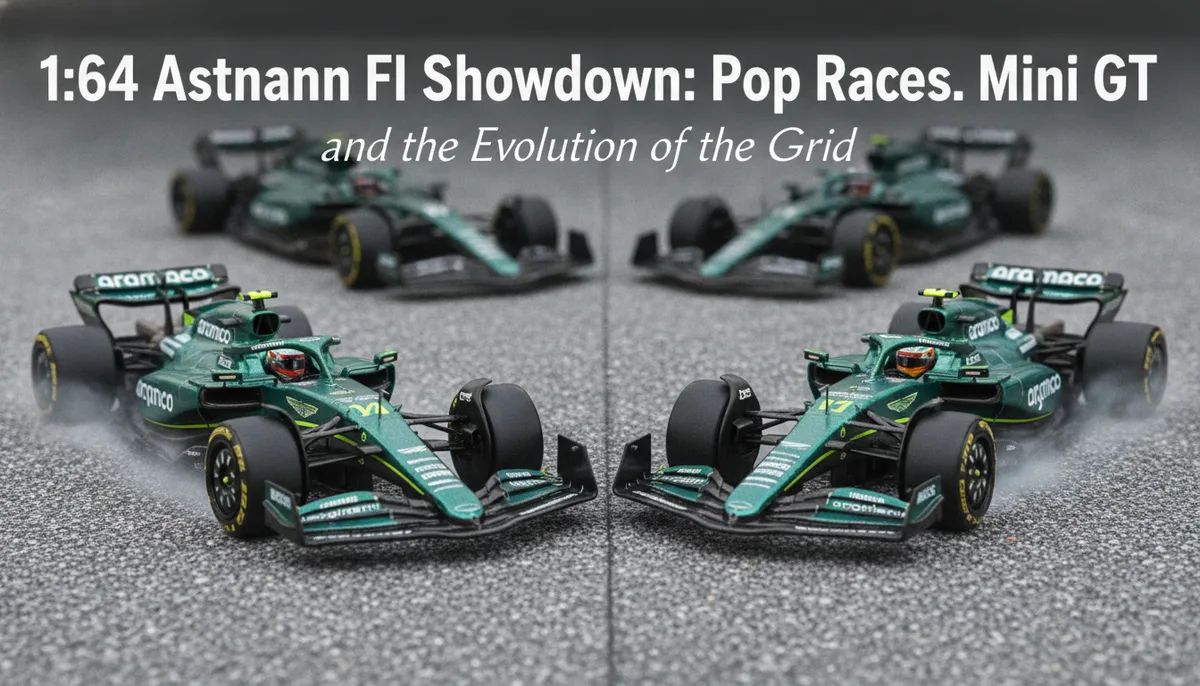
1:64 Aston Martin F1 Showdown: Pop Race vs. Mini GT and the Evolution of the Grid
The world of 1:64 scale diecast collecting has undergone a massive transformation over the last five years. What was once a scale dominated by "toy" representations is now a battlefield for high-end, collector-grade precision models. Nowhere is this rivalry more apparent than in the Formula 1 segment. For collectors of the "British Racing Green" contingent, a long-awaited arrival has finally hit the shelves: the 2023 and 2024 Aston Martin F1 cars from Pop Race and Mini GT.
After more than a year on the preorder lists, these two models have arrived almost simultaneously, offering a fascinating look at how two of the industry’s most exciting brands tackle the same subject matter. Whether you are a fan of Fernando Alonso’s veteran mastery or Lance Stroll’s Canadian grit, these models represent a significant step forward for the 1:64 F1 grid.
The Long Wait for the AMR23 and AMR24
Patience is a virtue in the diecast world, especially when dealing with the intricate licensing and production cycles of modern Formula 1. The Pop Race AMR23 (Fernando Alonso, #14) and the Mini GT AMR24 (Lance Stroll, #18) both faced significant delays, leading some collectors to wonder if the Pop Race version would ever see the light of day.
The arrival of these models from Tokyo Station marks a milestone. Both brands have secured full licensing, which is a critical factor for serious collectors. Seeing the "Official Product" F1 team stickers on the packaging provides that extra layer of authenticity that separates a true collectible from a generic racing car.
Choosing between Alonso and Stroll isn't just about driver preference; it’s about capturing the evolution of the team. The AMR23 was the car that saw Alonso frequently "troubling the podium," while the AMR24 represents the current trajectory of the team as they prepare for the era of Adrian Newey’s chassis design and Honda power units.
Pop Race Aston Martin AMR23 Fernando Alonso 1:64
Packaging and First Impressions: Two Different Philosophies
When these models arrive, the first thing you notice is the packaging. Pop Race sticks to its tried-and-true formula: a standard cardboard box with a secure plastic insert. It’s functional, collector-friendly, and easy to stack.
Mini GT, however, occasionally adds an extra layer of protection. In this instance, the AMR24 came with an additional plastic blister over the standard oblong box. While some collectors prefer to keep everything mint-in-box, many will find themselves cutting open the blister to access the standard box for easier storage.
Once removed from their boxes, the models share a surprising amount of DNA. Both have a satisfying heft, a result of the materials used to ensure they feel like premium items rather than lightweight plastic toys. For those looking to understand the broader market of high-quality diecast, consulting The Diecast Collector Pro Master Buying Guide: Precision, Quality, and Value can help put these 1:64 gems into perspective against larger scales.
Technical Analysis: Rolling, Tires, and Construction
One of the most debated aspects of 1:64 F1 models is their "rollability." Many high-end brands sacrifice movement for static detail, but both Pop Race and Mini GT have managed to strike a balance.
The Rolling Performance
Both models roll exceptionally well, moving with a freedom that is often missing from brands like Spark. However, if we are splitting hairs, the Mini GT AMR24 has a slight edge. It feels just a bit more "free" on its axles. Interestingly, the Mini GT’s front wing sits noticeably lower to the ground than the Pop Race version, giving it a more aggressive, "planted" stance that reflects the ground-effect era of modern F1.
Tire Compounds and Details
In a brilliant nod to race strategy, the two brands have opted for different tire compounds:
- Pop Race AMR23: Features the white-marked Pirelli "hard" compound tires.
- Mini GT AMR24: Sports the red-marked Pirelli "soft" compound tires.
Both sets are made of proper rubber, providing the right texture and grip. The presence of driver figures with fully decorated helmets in both cars adds a level of realism that is now becoming the standard for the $15–$25 price bracket.
Mini GT Aston Martin AMR24 Lance Stroll 1:64
The "Spark" Contrast: Why the Newcomers are Winning
To truly appreciate the quality of the Pop Race and Mini GT Astons, one must compare them to the "old guard." Comparing these new releases to the Spark AMR22 (Sebastian Vettel, #5) reveals a stark difference in manufacturing philosophy.
Spark has long been the go-to for comprehensive F1 grids, but their 1:64 models often feel fragile. The Spark AMR22 is significantly lighter and often suffers from QC issues; it rarely sits perfectly square on its wheels, and the wheels themselves often rub against the aerodynamic fairings, preventing them from rolling at all.
While Spark’s coverage is unmatched, their models feel like delicate ornaments. In contrast, Mini GT and Pop Race feel like engineered machines. With even brands like Majorette entering the licensed F1 space, the pressure is on Spark to modernize their construction methods to justify their place in a collector's cabinet.
Historical Context: From DBR5 to the Modern Era
Collecting these modern Astons is even more rewarding when viewed through the lens of history. The Aston Martin name in F1 isn't a new phenomenon, though its early years were brief. The 1960 Aston Martin DBR5, famously replicated by Lesney Matchbox (model 19c), shares a similar "racing green" heritage.
Much like the modern team’s recent struggles to maintain their podium pace, the DBR5 was largely uncompetitive in its day. However, seeing the 1960s silhouette alongside the 2024 AMR24 shows just how much the "science of speed" has evolved. For collectors interested in how brand legacies are maintained across decades, exploring The Matchbox Premium Evolution: Why Collectors Batch C and the Move to All-Metal Bases Matter provides excellent context on how heritage brands are fighting to stay relevant.
Displaying and Protecting Your F1 Fleet
Because these 1:64 models feature delicate wings, antennas, and cameras, they require proper housing. Unlike standard diecast cars that can be tossed into a bin, the aerodynamic appendages on these F1 cars are prone to snapping if mishandled.
If you are building a "grid" of 1:64 cars, consider a dedicated display solution. Modern F1 cars are significantly longer than the sports cars of the 1990s, so ensure your display case can accommodate their footprint. For a deep dive into the best ways to showcase these precision models, refer to our Display Case Buyer's Guide: Protecting Your Investment.
Final Verdict: Which One Should You Buy?
If you are a completionist, the answer is both. The subtle differences in the AMR23 and AMR24 liveries, combined with the different tire compounds and driver figures, make them distinct enough to warrant a spot in the same cabinet.
However, if you must choose one:
- Choose Pop Race if you want what might be the best model the brand has ever produced. The AMR23 is a triumph of deco and build quality.
- Choose Mini GT if you value the "rolling" experience and a slightly more aggressive, lower stance.
Both models prove that the 1:64 F1 market is healthier than ever. As we look toward the future of Aston Martin—with the potential of Newey-designed cars on the horizon—these models serve as a high-quality snapshot of a team on the rise. Happy collecting!